How to Get Diagnosed With Endometriosis Without Surgery: What's Actually New in 2026
Last updated: July 14, 2026
This page exists because the accurate version of this story is getting lost. In the last week, headlines about a new endometriosis test have spread fast, and a lot of what's circulating is incomplete, oversimplified, or flat-out wrong. This is the fully sourced version. Every claim below is cited. It gets updated as the facts change.
The Short Version
Three non-invasive endometriosis tests were reviewed by UK health authority NICE. Two were recommended, one was not.
The recommended tests, Ziwig Endotest (saliva) and EndoSure (gut sensor), are complementary to surgery and imaging, not replacements for them.
This is draft guidance, open for public consultation until July 27, 2026. It is not finalized policy.
Neither test tells you your disease stage or severity. Both give a yes-or-no result only.
None of this is available in the US yet.
Deep excision surgery remains the only method that both diagnoses and treats endometriosis with certainty, and is still considered the gold standard.
If you only read one section, that's the one. Everything below is the detail behind it.
What Actually Happened
On July 7, 2026, the UK's National Institute for Health and Care Excellence (NICE) issued draft early use healthtech guidance reviewing three non-invasive diagnostic tests for endometriosis, aimed at addressing average NHS wait times that exceed nine years.
Two tests were recommended:
Ziwig Endotest, a saliva test analyzing 109 microRNAs, with results in 2-3 weeks
EndoSure, a 45-minute test measuring electrical signals in the gut via abdominal sensor pads, with immediate results
One test was not recommended:DotEndo, another saliva-based biomarker test from US company DotLab, was reviewed at the same time and found to have insufficient evidence. This detail matters, because it means NICE's process discriminated between technologies rather than approving anything with an AI or biomarker label attached.
Both recommended tests are explicitly positioned as complementary to existing clinical pathways, meant to be used in primary care when abdominal exams are normal and ultrasound is negative, inconclusive, declined, or unsuitable. Neither replaces a surgical referral when one is needed.
This is a 3-year evidence-generation period, not a permanent, settled rollout. NICE says plainly that more data is still needed on long-term effectiveness and cost-effectiveness, and will review progress annually.
Critically, this is still draft guidance. The consultation document is open for public feedback until July 27, 2026. It represents the direction the NHS is heading, not a finalized policy. Any content, including this page, that treats it as fully locked in is getting ahead of the facts.
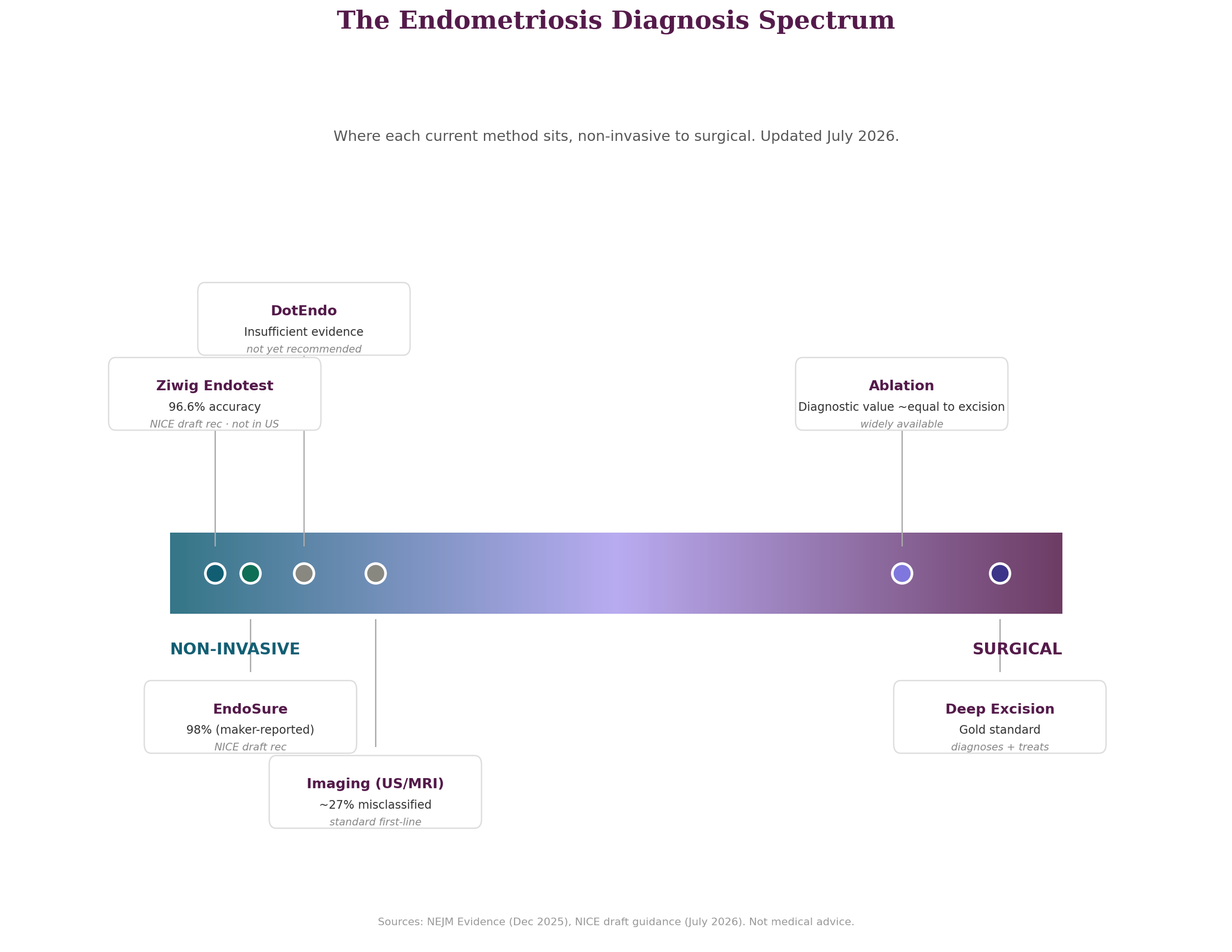
The endometriosis diagnosis spectrum: non-invasive tests vs. surgical options, 2026
The Data Behind Ziwig Endotest
The strongest science in this story belongs to Ziwig Endotest. A study published in NEJM Evidence in December 2025 followed 971 symptomatic people across 17 hospitals in France, with blinded diagnostic review. Inclusion criteria required people aged 18 to 43 with severe pelvic pain and negative or uncertain imaging.
Results:
Accuracy: 96.6%
Sensitivity: 97.3%
Specificity: 94.1%
Positive predictive value: 98.2%
Negative predictive value: 91.3%
The single most important number in the whole story: among surgically confirmed patients, the saliva test's misclassification rate was 4.6%, compared to 27.2% for imaging (ultrasound and/or MRI). Underestimation and overestimation rates followed the same pattern (2.4%/2.2% for the saliva test vs. 15.1%/12.2% for imaging).
If your imaging ever came back "normal" while your pain said otherwise, that comparison is the most important thing on this page. It means imaging has been wrong roughly one in four times in this study population. You were never imagining it.
EndoSure's accuracy claims (98-99%) are currently maker-reported, not yet backed by an independently peer-reviewed study at the same scale and rigor as Ziwig's NEJM Evidence publication. That doesn't mean the claim is false. It means the evidence tiers are different, and it's worth knowing that distinction rather than treating both numbers as equivalent.
What These Tests Do Not Do
This is the part getting lost in the excitement, and it's worth stating as plainly as possible:
Both tests return a yes-or-no result. That's it. Neither measures disease severity, neither stages your endometriosis (no ASRM classification, no Enzian classification), and neither tells you lesion depth or location. Neither is a tool for surgical planning. If a headline implies a saliva test can tell you how severe your disease is or what kind of surgery you need, the headline is wrong.
Deep excision surgery remains the only method that both diagnoses and treats endometriosis with histological certainty. These new tests are diagnostic aids that can shorten a wait. They are not a substitute for surgical evaluation.
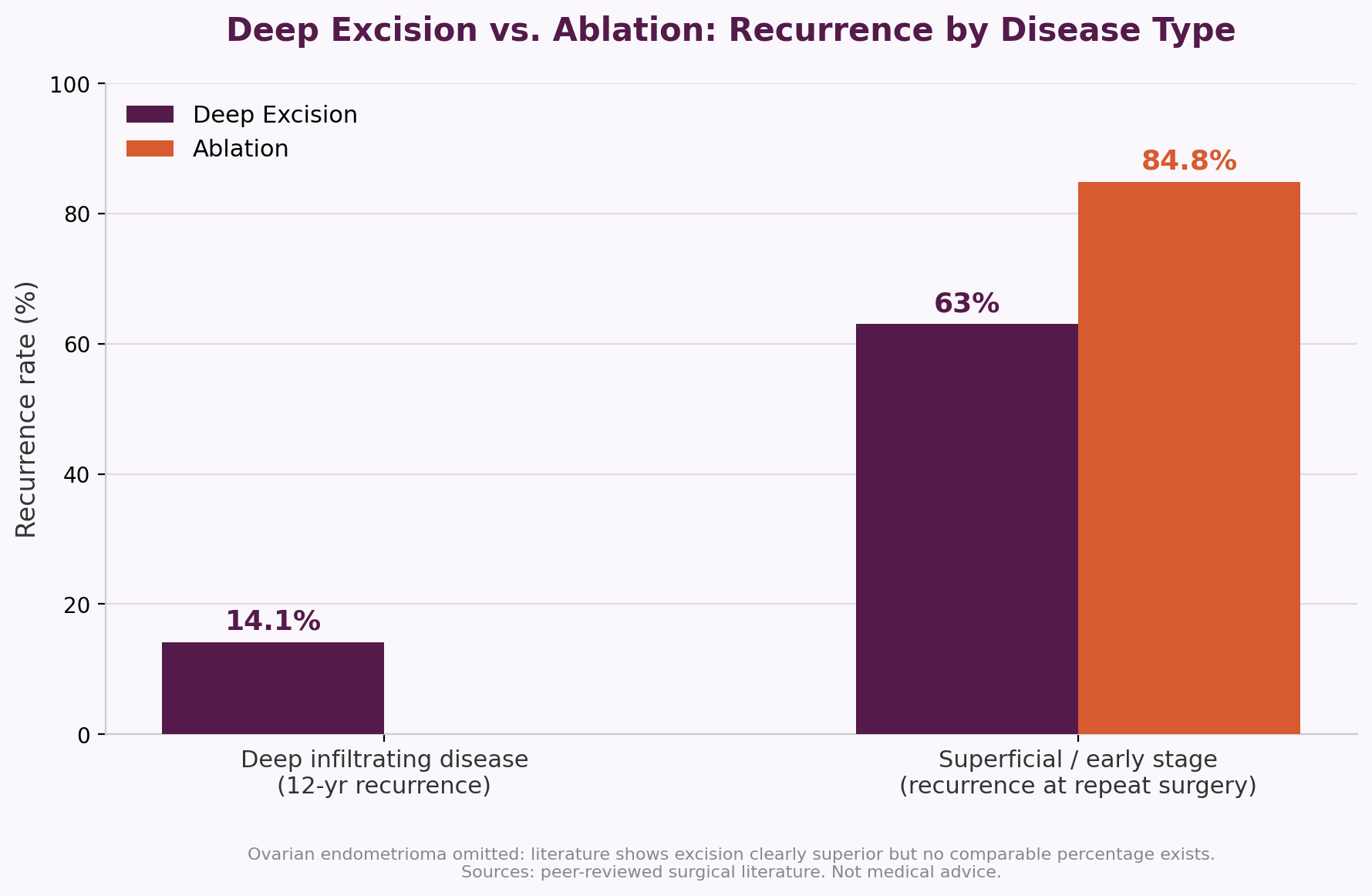
Deep excision vs. ablation: recurrence rates by disease type
If You Already Had Surgery (Excision or Ablation)
Here's the honest answer nobody's giving this audience: this test hasn't been studied for your situation. There is no published data comparing the saliva signature against surgical technique, no data correlating it to disease stage, and no research yet on whether the signature changes, persists, or normalizes after surgery. It currently cannot tell you anything about recurrence, and it would not change your care if you took it today.
That's not a loss. Your surgical diagnosis already answered the question this test is only just learning to ask. You don't need a saliva sample to validate a diagnosis a surgeon already confirmed.
If You're Currently Waiting
If you're in the UK, this is genuinely good news with real limits attached: early access, not a guarantee, still draft, and complementary to your existing referral rather than a replacement for it.
If you're in the US, the direct version is simpler: none of this is available to you yet. As of this writing, Ziwig Endotest is CE-marked and rolling out across parts of Europe, the Middle East, and Asia, with no FDA clearance and no announced US timeline. That's frustrating to hear, and it's also just true. Progress here is happening in patches, not all at once.
While you wait, the thing that changes your next appointment isn't a headline about a test you can't access. It's how clearly you can describe what's happening in your body to a clinician who may not be listening closely enough yet.
Myths Circulating Right Now
Myth: "There's a new test that replaces surgery for endometriosis now." Fact: Both recommended tests are explicitly complementary, not replacements. Surgery, particularly deep excision, remains the only method offering both definitive diagnosis and treatment.
Myth: "This test tells you your stage or how severe your endometriosis is." Fact: It's a yes-or-no result only. No staging, no severity, no lesion location.
Myth: "This is now official NHS policy." Fact: It's draft guidance, open for public consultation until July 27, 2026.
Myth: "This test is available in the US now." Fact: It is not. No FDA clearance, no announced US timeline.
Myth: "If I already had surgery, this news is relevant to my care." Fact: Not currently, since the test hasn't been studied for post-surgical or recurrence scenarios.
Frequently Asked Questions
Is the Ziwig Endotest available in the US? No. As of this writing, it is CE-marked in parts of Europe, the Middle East, and Asia, with no FDA clearance or announced US availability.
Does the endometriosis saliva test replace surgery? No. It's positioned as complementary to existing diagnostic pathways, not a replacement for surgical evaluation or imaging.
Can a saliva test tell you the stage of endometriosis? No. Both Ziwig Endotest and EndoSure return a yes-or-no result only. Neither measures disease stage, severity, or lesion location.
What can I do while waiting for an endometriosis diagnosis? Focus on clear, specific symptom documentation and self-advocacy language for appointments, since that's within your control regardless of which diagnostic tools are or aren't available in your region yet.
Does an endometriosis test work after a normal ultrasound? This is exactly the population the Ziwig Endotest study focused on: people with severe pain and negative or uncertain imaging. In that population, the saliva test's misclassification rate was substantially lower than imaging's in the same study.
The Version of This Story Worth Telling
Not "revolutionary test solves endometriosis diagnosis." That's the version built for a press release. The truer version: a real, well-validated tool now exists for a specific slice of patients, in specific countries, for a specific yes-or-no question, while still in a draft, consultation-pending phase. Meanwhile, the surgically diagnosed and the still-waiting are living proof that the system moves in patches, not all at once. Both things can be true. Neither means you were wrong to trust your own body before the tools caught up.
Endometriosis affects roughly 1 in 10 people who menstruate, and disproportionately impacts women. That reality doesn't change based on a single headline, and neither does the fact that you deserve a straight answer over a hyped one.
Want the full picture, not just this news cycle?
This post covers what changed this month. For the complete landscape, every current diagnostic method, deep excision, ablation, imaging, and where all three new tests stand, visit the Navigating Endo hub, your home base for what's actually known about getting diagnosed, treated, and believed.
Sources: Bendifallah et al., NEJM Evidence, Dec 2025 (DOI: 10.1056/EVIDoa2400195); NICE draft early use healthtech guidance, July 7, 2026, open for consultation until July 27, 2026; Scheck et al., Aust N Z J Obstet Gynaecol, 2024; peer-reviewed surgical literature on excision vs. ablation outcomes (full citation log available on request).